


Continuing in our exploration of employees’ First Amendment rights, we now turn to government contractors. Can government contractors be fired for exercising free speech? Of course, it depends.
What are government contractors?
A government contractor is someone who performs work on a contract with the government. Contractors can be self-employed, or they can be the employees of a private company that has a contract with the government. However, depending on several factors —namely, how much control it has over the contractor —the government may be considered a joint employer under the law. If that is the case, the contractor can seek damages from the government, the private employer, or both, for illegal employment actions, such as discrimination.
Can the government fire a contractor for exercising free speech?
In 1996, the Supreme Court ruled that, in certain circumstances, government contractors have the same speech protection as government employees. Therefore, it may be illegal for a government agency to terminate a contractor’s employment or ask for the contractor’s removal from the contract for exercising free speech. In Board of County Commissioners, Wabaunsee County, Kansas v. Umbehr, 518 U.S. 668 (1996), the Supreme Court recognized that both government employees and government contractors have the critical ability to speak on matters of public concern. 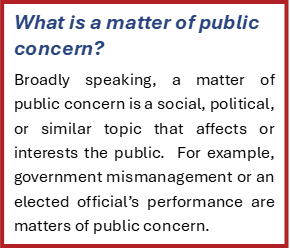
The Court considered whether the first amendment restricts governments in terminating independent contractors due to off-duty speech. Significantly, protected speech does not include written and verbal comments an employee makes within the scope of their job duties; the government employer can terminate or request the removal of a contractor for on-the-job speech. See Connick v. Myers, 461 U.S. 138, 146 (1983). For government employees and contractors alike, the adverse employment action must be because of their speech on matters of public concern. The government employer then has a chance to show that it would have terminated the employment contract regardless of the speech. Further, the government will likely prevail if it can show that the “government’s legitimate interests…outweigh the free speech interests at stake.” Promoting workplace efficiency and preventing disruption are examples of legitimate government interests.
Can an attorney help me sue the government for removing me from a contract?
If the government terminated your contract because you exercised free speech, it may be helpful to consult with an attorney. An experienced employment lawyer can assess the facts of your case and advise you about whether you may have a claim. Alan Lescht and Associates, P.C., has extensive experience representing government contractors in employment disputes against both private sector employers and government agencies. Contact us today to schedule a consultation. Discuss your situation with an experienced attorney, and learn how we can help you achieve the best possible outcome.
